
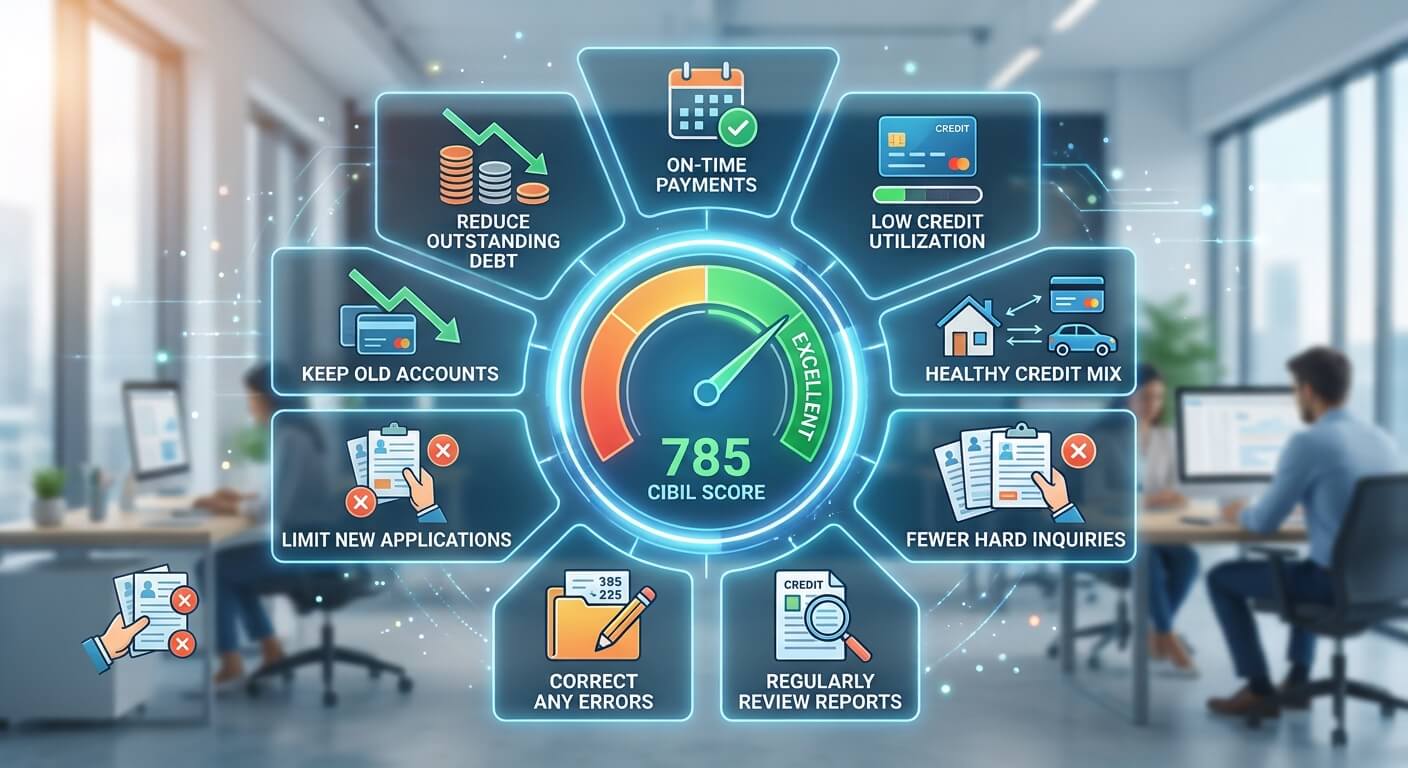
| Quick answer: To lift your CIBIL score before borrowing, pay every EMI and bill on time, keep your credit utilisation low, fix errors on your report, clear small dues, avoid a flurry of applications, keep older accounts open, limit hard enquiries, and maintain a healthy mix of credit. Even a few months of these habits can move a borderline score into a better band and win you a lower rate. Here are the eight that matter. |
Your credit score is the first thing a lender reads, and it shapes not just whether you are approved but at what rate. A stronger score moves you into a better band, which can save a meaningful sum over a loan’s life. Preparing your score before you apply for a business loan is one of the highest-return steps you can take, and most of it comes down to a handful of habits. Here are eight ways to improve it before you borrow.
Why your CIBIL score matters for a business loan
Lenders price a loan on risk, and your credit score is their quickest read of how reliably you repay. A higher score signals lower risk, which earns a better rate and a larger amount, while a weak one means rejection, a higher rate, or a smaller offer. TransUnion CIBIL generally treats scores around 750 and above as strong, and the gap between a borderline score and a strong one can be worth real money over a loan’s tenure.
The good news is that a score is not fixed. It responds to your behaviour, often within a few months, so the period before you apply is exactly when preparation pays off. The Reserve Bank of India frames lending around creditworthiness, so working on the signals a lender checks is working directly on the terms you will be offered.
Preparation also widens your options. A stronger profile means more lenders will consider you and more products open up, from unsecured loans to better-priced secured ones. Development institutions such as SIDBI stress that well-documented, creditworthy firms find credit easiest to access, which begins with a healthy score. The eight habits below are the most effective ways to build one.
Eight ways to lift your score
1. Pay every EMI and bill on time
Payment history is the single biggest factor in your score. One missed or late payment can pull it down sharply, so pay every loan EMI and card bill on or before the due date. Setting reminders or auto-pay for at least the minimum protects the most important signal a lender sees.
2. Keep your credit utilisation low
Using too much of your available credit limit signals strain. Keeping your card and credit-line usage to a modest share of the limit, rather than running it to the top, helps your score. If you regularly use a lot, paying down before the statement date lowers the utilisation that gets reported.
3. Fix errors on your credit report
Reports sometimes carry mistakes (a loan shown as open after you closed it, or a payment wrongly marked late) that drag your score down unfairly. Check your report before you apply, and raise a dispute to correct any error. Clearing a wrongful mark can lift a score with no change to your actual behaviour.
4. Clear small outstanding dues
Small unpaid amounts, such as a forgotten card balance or a minor overdue, can weigh on your score out of proportion to their size. Clearing these before you apply removes easy negatives and shows a clean slate. It is among the quickest wins available in the run-up to a loan.
5. Avoid a flurry of loan applications
Applying to many lenders in a short span triggers multiple hard enquiries and makes you look credit-hungry, both of which hurt your score. Check your business loan eligibility first and apply selectively where you fit, rather than spraying applications and hoping one lands.
6. Keep older credit accounts open
The length of your credit history helps your score, so closing a long-held card or account can shorten it and lower the score. Unless an account carries a cost you want to avoid, keeping older, well-managed accounts open preserves the history that works in your favour.
7. Limit hard enquiries
Every formal loan or card application creates a hard enquiry on your report, and several in a short period dent your score. Space out applications, and use soft checks or eligibility tools where available, so you are not accumulating enquiries that make you look credit-hungry just before a big application.
8. Maintain a healthy credit mix
A balanced mix of credit types, handled well, reflects positively on your profile. You do not need to take on credit you do not require, but managing a sensible range responsibly, rather than relying on a single type, supports a stronger score over time and shows you can handle different obligations.
What a strong profile looks like
| Signal | What good looks like |
| Payment history | Every EMI and bill paid on time |
| Credit utilisation | A modest share of your limit |
| Report accuracy | No errors or wrongful marks |
| Outstanding dues | Small balances cleared |
| Recent enquiries | Few, spaced-out applications |
The guidance is indicative; the exact weighting varies, and your report is the authoritative record of where you stand.
The bottom line
Your CIBIL score shapes the rate and amount you are offered, not just the yes or no, and it responds to a handful of habits. Pay on time, keep utilisation low, fix report errors, clear small dues, apply selectively, keep older accounts open, limit enquiries, and maintain a healthy mix. Start a few months before you apply, and you can move a borderline score into a band that earns a materially better business loan interest rate and a larger amount. Preparation here is the cheapest thing you can do.
Frequently asked questions
How can I improve my CIBIL score before applying for a business loan?
Pay every EMI and bill on time, keep credit utilisation low, fix any errors on your report, clear small dues, apply selectively to limit hard enquiries, and keep older accounts open. These habits can lift a borderline score within a few months and win you a better rate.
How long does it take to improve a credit score?
It depends on your starting point and what is pulling the score down. Correcting a report error can help quickly, while building a consistent payment record takes a few months. Starting well before you apply gives the improvements enough time to show on your report.
What CIBIL score do I need for a business loan?
Lenders generally treat scores around 750 and above as strong, which opens better rates and larger amounts, though a lower score may still qualify at a higher rate or smaller amount. Improving the score before applying widens your options and lowers your cost. It is worth checking your score a few months ahead, so any improvement has time to reflect before a lender sees it.