Monday, March 2, 2026
Home Blog Page 9

What is the journal entry for cash withdrawn from bank for office use?

0

-This question was submitted by a user and answered by a volunteer of our choice.

Cash Withdrawn from Bank for Office Use

The cash withdrawn from the bank for office use shall be recorded in the books as;

Journal Entry (Using modern rules of accounting)

cash withdrawn from bank for office use


Why is the cash account debited?

When we withdraw an amount from the bank we receive cash i.e the entity’s cash in hand balance increases. As per the modern rules of accounting, we debit the increase in an asset. And so in the above entry cash account is debited.


Why is the bank account credited?

When an amount is withdrawn from the bank the entity receives cash while the balance in his bank account reduces. Thus as per the modern rules of accounting, we credit the decrease in an asset.

The bank account of an entity is shown under the head of current assets and so it’s credited since the withdrawals lead to a reduction in the balance with the bank. Hence, in the above entry bank account is credited.

Journal Entry (Using golden rules of accounting)

Cash withdrawn for office use


Why is the cash account debited?

As per the golden rule of accounting, a cash account is classified as a real account. As per the rule for a real account, we debit what comes in and credit what goes out. Hence, when the cash is withdrawn for office use we receive cash hence, the cash account is debited.


Why is the bank account credited?

As per the golden rule of accounting, the bank account is classified as a personal account. As per the rule for a personal account, we debit the receiver and credit the giver. Here, the Bank balance reduces i.e bank is the giver hence, it’s credited.


What is journal entry for commission received?

0

-This question was submitted by a user and answered by a volunteer of our choice.

Commission Received refers to a percentage amount received by the company (or) an individual on the total sales incurred. It is an indirect income/revenue recorded on the credit side of the profit and loss account. The term “commission” is more likely used in the stock market which is paid to a broker on the sale of shares (or) securities.

Journal Entry for Commission Received

Nowadays many organization uses a bank account for every business transaction i.e., either to make or receive payment. The journal entry on the commission received can be recorded in two different approaches of accounting. They are,

1. Traditional Accounting Approach

Particulars L.F. Amount Nature of Account Accounting Rule
Bank a/c Amt Personal Debit- The Receiver
 To Commission Received a/c  Amt Nominal Credit- All Incomes and Gains

(Being commission received)


2. Modern Accounting Approach

Particulars L.F. Amount Nature of Account Accounting Rule
Bank a/c Amt Asset Debit- The Increase in Asset.
 To Commission Received a/c  Amt Income Credit- The Increase in Income.

(Being Commission received)


Example

On 1st March, Anna Ltd. received a commission amounting to 70,000 through cheque. Journalise the following transaction.

Date Particulars L.F. Amount Nature of Account Accounting Rule
1st March Bank a/c 70,000 Asset Debit- The Increase in Asset
 To Commission Received a/c  70,000 Income Credit- The Increase in Income.

(Being commission received through cheque)


What is the journal entry for outstanding salary?

0

-This question was submitted by a user and answered by a volunteer of our choice.

Outstanding Salary

Example- Company A Ltd pays their employees a monthly salary of 25,000. The company has a policy that it pays the previous month salary to its employees on the 10th of next month. Salary for March is due and is duly to be paid by the 10th of April as per the company policy. Journalise the following transaction for salary due and paid in the books of ABC and Co.

In the Books of ABC and Co.

Date Particulars L.F. Amount Nature of Account Accounting Rule
31st March Salary a/c       Dr 25,000 Nominal Debit- All Expense and Losses
 To Outstanding Salary a/c  25,000 Representative Personal Credit- The Giver

(Being salary due for March)


Date Particulars L.F. Amount Nature of Account Accounting Rule
1st April Outstanding Salary a/c       Dr 25,000 Representative Personal Debit- The Receiver
 To Cash/Bank a/c  25,000 Real Credit- What goes out of the business

(Being salary paid)


Accounting Treatment

Outstanding salary is added to the salary and shown on the debit side of profit and loss account. It is further shown under the head current liabilities in the balance sheet. Outstanding salary is also known as Salary due (or) Salary payable.


Modern Accounting Approach

We will record the same transaction by following the modern rules of accounting

In the Books of ABC and Co.

Date Particulars L.F. Amount Nature of Account Accounting Rule
31st March Salary a/c       Dr 25,000 Expense Debit- The Increase in Expense
 To Outstanding Salary a/c  25,000 Liability Credit- The Increase in Liability

(Being salary due for March)


Date Particulars L.F. Amount Nature of Account Accounting Rule
1st April Outstanding Salary a/c       Dr 25,000 Liability Debit- The Decrease in Liability
 To Cash/Bank a/c  25,000 Asset Credit- The Decrease in Asset

(Being salary paid)


What is started business with cash journal entry?

0

-This question was submitted by a user and answered by a volunteer of our choice.

To begin with, three types of businesses can be commenced, i.e. sole proprietorship, partnership, and joint-stock company. As we all know, to start any business, a certain sum of money has to be invested by the owner that is known as the capital of the business in terms of accounting.

Journal entry for started business with cash

The Cash A/c is debited as it is an asset for the business, and the Capital A/c is credited as it is a liability for the business according to the business entity concept.

1. According to the golden rules of accounting:

Cash a/c Debit Debit what comes in
To Capital a/c Credit Credit the giver

(being business commenced with cash)


2. According to the modern rules of accounting:

Cash a/c Debit Debit the increase in asset
To Capital a/c Credit Credit the increase in capital

(being business commenced with cash)


Example

Mr A commenced business with cash (capital) amounting to 1,00,000. The journal entry in the books of Mr A is as follows.

Cash a/c Debit 1,00,000
To Capital a/c Credit 1,00,000

(being business commenced with cash)


What is the journal entry for cash withdrawn from bank?

0

In this modern business world, Banks performs various functions to an organization such as it accepts various deposits from the debtors, making payment to the creditors on the standing instructions of the company. Banks provide various agency and miscellaneous services to an organization.

The Journal entry for cash withdrawn from the bank is a contra entry. Cash can be taken from the bank for two uses either for personal use (or) business use. I am assuming that cash is withdrawn from the bank for business use.


Journal Entry for Cash Withdrawn from Bank

This journal entry can be recorded from two different accounting perspectives they are;

1. Traditional Accounting Perspective

Particulars L.F. Amount Nature of Account Accounting Rule
Cash a/c Amt Real Debit- What comes into the business
 To Bank a/c  Amt Personal Credit- The Giver

(Being cash withdrawn from the bank)


2. Modern Accounting Perspective

Particulars L.F. Amount Nature of Account Accounting Rule
Cash a/c Amt Asset Debit- The Increase in Asset
 To Bank a/c  Amt Asset Credit- The Decrease in Asset

(Being cash withdrawn from the bank)


Example

On 15th May, Anna Ltd withdraws 5,00,000 from their Bank account for business purposes. Journalise the following transaction.

Date Particulars L.F. Amount Nature of Account Accounting Rule
15th May Cash a/c 5,00,000 Asset Debit- The Increase in Asset
 To Bank a/c  5,00,000 Asset Credit– The Decrease in Asset

(Being cash withdrawn from the bank)


What is the journal entry for sold goods on credit?

0

-This question was submitted by a user and answered by a volunteer of our choice.

In the modern business world, sales are made on a credit as well as cash basis. Even though there’s a high risk of bad debts in selling goods on a credit basis, the companies prefer the same to develop customer loyalty and meet the cut-throat competition.

‘Sold goods on credit’ is nothing but the sale of goods on a credit basis i.e. providing goods to the customer with an expectation of receiving the payment in the future. This amount owed by the debtor leads to an increase in the accounts receivables of the company and is a current asset.


Journal entry for sold goods on credit

The respective debtor account is debited while the sales account is credited.

1. According to the golden rules of accounting:

Debtor’s a/c Debit Debit  the receiver
To Sales a/c Credit Credit all incomes and gains

(being goods sold on credit)


2. According to the modern rules of accounting:

Debtor’s a/c Debit Debit  the increase in asset
To Sales a/c Credit Credit the increase in revenue

(being goods sold on credit)


Example

XYZ Ltd. sold goods amounting to 50,000 to Mr A on credit. The journal entry in the books of XYZ Ltd. is as follows:

Mr A’s a/c Debit 50,000
To Sales a/c Credit 50,000

(being goods sold on credit)


Can you give me a list of debit and credit items in trial balance?

0

-This question was submitted by a user and answered by a volunteer of our choice.

Trial Balance

Are you facing difficulty in understanding the crux of the trial balance? I would like to help you by providing the meaning followed by items to be included on either side of the trial balance.

Meaning

The term trial balance refers to the total of all the general ledger balances. It is a statement prepared at a certain period to check the arithmetic accuracy of the accounts (i.e., whether they are mathematically correct and balanced). It contains a list of all the general ledger accounts.

Trading account, Profit and Loss account and Balance Sheet are prepared according to the ledger balances as posted in the trial balance.

Now it’s time to learn about the various items which are placed on either side of the trial balance.


Items that appear on the debit side of the trial balance

Generally, assets and expenses have a positive balance so they are placed on the debit side of the trial balance. An asset and expense increases when it is debited and vice versa

Exclusive List of Items

  1. Land and Buildings
  2. Plant and Machinery
  3. Furniture and Fixtures
  4. Office Tools and Equipment
  5. Cash at Bank
  6. Cash in Hand
  7. Motor Van
  8. Loss from the sale of fixed assets
  9. Travelling charges
  10. Printing and postage expenses
  11. Legal expenses
  12. Selling and distribution expenses
  13. Sundry debtors
  14. Bills receivables
  15. Commission paid
  16. Rent paid
  17. Interest paid
  18. Discount allowed
  19. Opening stock
  20. Purchases
  21. Prepaid expenses
  22. Advertisement expenses
  23. Bad Debts
  24. Wages and salaries
  25. Bank charges


Items that appear on the credit side of the trial balance

Generally capital, revenue and liabilities have credit balance so they are placed on the credit side of the trial balance. The capital, revenue and liability increase when it is credited and vice versa.

Exclusive List of Items

  1. Sundry Creditors
  2. Bank Overdraft/Loan
  3. Bills Payables
  4. Sales (Revenue)
  5. Purchase Returns
  6. Common stock
  7. Un-earned revenues
  8. Retained earnings
  9. Rent Received
  10. Interest Received
  11. Discount from Creditors
  12. Discount on Purchases
  13. Dividend Received
  14. Interest on Drawings
  15. Bad Debts recovered
  16. Provision on Bad Debts (Cr.)
  17. Apprentice premium
  18. Miscellaneous/Sundry income
  19. Commission received
  20. Bank interest received
  21. Compensation received
  22. Outstanding income
  23. Income from investments
  24. Bonds payable
  25. Other incomes


What is the journal entry for purchased goods on credit?

0

-This question was submitted by a user and answered by a volunteer of our choice.

It is believed that every organization requires goods for running its business. Goods can be purchased in two different ways i.e. on cash and credit. Most of the companies prefer credit purchase of goods over cash. I would like to explain to you the meaning of credit purchases followed by a journal entry and a simple practical example.

Purchased Goods on Credit

In simple terms, when an organization (or) customer purchases the goods from the seller (or) supplier and agrees to pay the consideration (value or price) of the goods on some future date then it is called credit purchases. Whenever credit purchase takes place accounts payable account/sundry creditor is created.

Accounts payable increases when the organization keeps on purchasing goods on credit. It is considered as a short-term debt that an organization owes to another organization during the ordinary (or) normal course of business.


Journal Entry for goods purchased on credit

  • Modern Accounting Approach
Date Particulars L.F. Amount Nature of Account Accounting Rule
1st March Purchases a/c 25,000 Expense Debit The Increase in Expense
 To Accounts Payable/Supplier a/c  25,000 Liability Credit– The Increase in Liability.


  • Traditional Accounting Approach
Date Particulars L.F. Amount Nature of Account Accounting Rule
1st March Purchases a/c 25,000 Nominal Debit All expenses and losses.
 To Accounts Payable/Supplier a/c  25,000 Personal Credit The giver.


Practical Example

On 1st June, Alex Co. purchases goods from Max Co. for 2,00,000 on a credit period of 30 days. Pass Journal entry for credit purchases in the books of Alex Co.


                                                            In the Books of Alex Co.

1. When Credit Purchase of goods takes place;

Date Particulars L.F. Amount Nature of Account Accounting Rule
1st June Purchases a/c 2,00,000 Expense Debit- The Increase in Expense.
 To Accounts Payable/Max Co. a/c  2,00,000 Liability Credit- The Increase in Liability.

(Being goods purchased from Max Co. on credit)


2. When consideration (value or price) of the goods is being duly paid;

Date Particulars L.F. Amount Nature of Account Accounting Rule
1st July Accounts Payable/Max Co. a/c 2,00,000 Liability Debit- The Decrease in Liability.
 To Cash/Bank a/c  2,00,000 Asset Credit- The Decrease in Asset.

(Being consideration paid for the goods purchased on credit)


What is paid electricity bill journal entry?

0

-This question was submitted by a user and answered by a volunteer of our choice.

There are various operating and Non-operating expenses incurred by an organization in its ordinary course of business such as Salaries, Legal expenses, Electricity charges etc. Therefore, it is the primary responsibility of an accountant to record all these expenses in the books of accounts for deriving genuine net profit at the end of the accounting year.


Journal Entry for Electricity Bill paid

1. Traditional Accounting Approach

Particulars L.F. Amount Nature of Account Accounting Rule
Electricity Bill a/c Amt Nominal Debit- All expenses and Losses
 To Bank a/c  Amt Personal Credit- The Giver.

(Being Electricity Bill paid)


2. Modern Accounting Approach

Particulars L.F. Amount Nature of Account Accounting Rule
Electricity Bill a/c Amt Expense Debit- The Increase in Expense.
 To Bank a/c  Amt Asset Credit- The Decrease in Asset.

(Being paid electricity bill)


Example

On 12th March, Alex Ltd. paid an electricity bill amounting to 8,000 through cheque. Journalise the following transaction in the books of Alex Ltd.

In the Books of Alex Ltd.

Date Particulars L.F. Amount Nature of Account Accounting Rule
12th March Electricity Bill a/c 8,000 Expense Debit- The Increase in Expense
 To Bank a/c  8,000 Asset Credit- The Decrease in Asset.

(Being paid electricity bill through cheque)


What is the journal entry for salary paid in advance?

0

-This question was submitted by a user and answered by a volunteer of our choice.

Salary paid in advance

The term salary paid in advance is also known as prepaid salary. salary paid in advance is initially recorded as an asset because it provides some future economic benefit and is charged at the time when the actual benefit is realized in the succeeding accounting period.

The amount of Prepaid salary is deducted from salary and shown on the debit side of the profit and loss account. It is further shown under the head current asset in the balance sheet. Hence prepaid salary (or) salary paid in advance is treated as adjustment entry.

Example- On 1st March, Company A Ltd paid 4 months prepaid salary amounting to 40,000 (10,000*4) to the employees of the company. Evaluate the treatment of the amount paid as prepaid salary by the company to the employees. Journalise the following transaction by recording payment and adjustment entry.


  • Traditional Accounting Approach

                                  Journal Entry in the books of Company A 

Date Particulars L.F. Amount Nature of Account Accounting Rule
March 1st Prepaid Salary a/c Dr 40,000 Representative Personal Debit– The receiver
 To Cash/Bank a/c  40,000 Real Credit– What goes out of the  business

(Being the payment for prepaid salary made)


Date Particulars L.F. Amount Nature of Account Accounting Rule
Aug 3rd Salary a/c              Dr 10,000 Nominal Debt– All Expenses and Losses
 To Prepaid Salary a/c  10,000   Representative Personal Credit– The Giver

(Being the amount of prepaid salary adjusted to salary)


  • Modern Accounting Approach-

We will record the same transaction by following the modern rules of accounting (widely recognized and followed all over the world).
                                       Journal Entry in the books of Company A

Date Particulars L.F. Amount Nature of Account Accounting Rule
March 1st Prepaid Salary a/c  Dr 40,000 Asset Debit– The Increase in Asset
 To Cash/Bank a/c  40,000 Asset Credit– The Decrease in Asset

(Being the payment for prepaid salary made)


Date Particulars L.F. Amount Nature of Account Accounting Rule
Aug 3rd Salary a/c             Dr 10,000 Expense Debit– The Increase in Expense
 To Prepaid Salary a/c  10,000 Asset Credit– The Decrease in Asset

(Being the amount of prepaid salary adjusted to salary)


What is the journal entry for purchase of machinery?

0

-This question was submitted by a user and answered by a volunteer of our choice.

A customer can purchase on two grounds: cash or credit. In the case of a cash purchase, the payment is made immediately by the customer however, in the case of a credit purchase, the payment is expected to be made in the future as per the agreement.

Journal entry for purchase of machinery on credit basis

Machinery a/c Debit Debit  the increase in asset
To Creditor/suppliers a/c Credit Credit the increase in liability

(being machinery purchased on credit)


Journal entry for purchase of machinery for cash

Machinery a/c Debit Debit  the increase in asset
To Cash Credit Credit the decrease in asset

(being machinery purchased for cash)


Example

1. Mr K purchased machinery from ABC Ltd. amounting to 20,000 on credit. The journal entry in the books of Mr K is as follows:

Machinery a/c Debit 20,000
To ABC Ltd. a/c Credit 20,000

(being machinery purchased on credit)


2. Mr A purchased machinery from XYZ Ltd. amounting to 20,000 on a cash basis. The journal entry in the books of Mr A is as follows:

Machinery a/c Debit 40,000
To Cash Credit 40,000

(being machinery purchased for cash)


What is the journal entry for unbilled revenue?

0

-This question was submitted by a user and answered by a volunteer of our choice.

Meaning of Unbilled Revenue

Unbilled Revenue refers to the revenue earned by an entity by rendering the goods or services in the current period ie. sale has been recognized but the entity has not yet issued the corresponding invoices to the customer.

Unbilled Revenue arises in situations where
a. Issue of the invoice is delayed, or
b. Invoice is issued only after the entire project/contract is completed.

Unbilled Revenue is presented as a current asset in the balance sheet.


Journal Entry for Unbilled Revenue

1. Entry for recording the revenue as per the accrual method

Unbilled Revenue A/c Debit Increase in asset
 To Revenue (Sales) A/c Credit Increase in Income

We have debited Unbilled Revenue A/c because it is an asset for the supplier entity as the invoice will definitely be raised in the near future for the goods or services already rendered and the corresponding consideration is still receivable from the customer.

We have credited the Revenue (Sales) A/c because the goods or services have been rendered by the entity. Therefore, as per the accrual method, it is recognized as revenue/sales by the seller entity in the current period itself.


2. Entry when the invoice has been issued to the customer

Unbilled Revenue is converted to Accounts Receivable once the invoice is issued.

Accounts Receivable A/c Debit Increase in asset
 To Unbilled Revenue A/c Credit Reversal of unbilled revenue debited earlier as the invoice has now been issued


Examples of Unbilled Revenue

Example 1 – Issue of the invoice is delayed

Software Ltd completed a software development & installation project worth 150,000 for ABC Ltd on 10th March 20×1. But it did not immediately issue an invoice. It issued the invoice on 05th April 20×1.

Following journal entries will be passed in the books of Software Ltd;

1. Entry for recording the revenue on completion of the project on 10/03/20×1

Unbilled Revenue A/c Debit 150,000
 To Revenue (Sales) A/c Credit  150,000


2. Entry at the time of issue of invoice on 05/04/20×1

Accounts Receivable-ABC Ltd A/c Debit 150,000
 To Unbilled Revenue A/c Credit  150,000


Example 2 – Invoice is issued only after the entire project/ contract is completed

R&D Ltd entered into a contract for carrying out research & development activities for Chemical Ltd. They agreed upon a contract price of 10 million which will be entirely invoiced at the end of the project. Out of 10 million, 3 million is related to the research phase and 7 million are for the development phase.

Research activities were completed in January 20×1 and development activities in the month of March 20×1. The invoice was raised in the month of April 20×1 for the entire project.


Following journal entries will be passed in the books of R&D Ltd.

1. Entry on completion of research phase in January 20×1 because it has completed its research obligation under the contract

Unbilled Revenue A/c Debit 3 million
 To Revenue (Sales) A/c Credit  3 million


2. Entry on completion of the development phase in March 20×1 because it has completed its development obligation under the contract

Unbilled Revenue A/c Debit 7 million
 To Revenue (Sales) A/c Credit  7 million


3. Entry at the time of issuance of invoice to Chemical Ltd and for recording receivable in the books in April 20×1

Accounts Receivable – Chemical Ltd A/c Debit 10 million
 To Unbilled Revenue A/c Credit  10 million


What is paid telephone bill journal entry?

0

-This question was submitted by a user and answered by a volunteer of our choice.

A company incurs several expenses arising from its operating activities. For example, rent, rates, taxes, telephone bills, electricity bills, etc. It is important to record the same in the books of accounts to ascertain the true financial position of a company.


Journal entry for paid telephone bill

The telephone charges a/c is debited and the respective cash or bank a/c is credited.

1. According to the golden rules of accounting:

Telephone charges a/c Debit Debit  all expenses and losses
To Cash a/c Credit Credit what goes out

(being telephone bill paid)


2. According to the modern rules of accounting:

Telephone charges a/c Debit Debit the increase in expense
To Cash a/c Credit Credit the decrease in asset

(being telephone bill paid)


Example

ABC Ltd. paid the telephone bill amounting to 10,000. The journal entry in the books of ABC Ltd is as follows:

Telephone charges a/c Debit 10,000
To Cash a/c Credit 10,000

(being telephone bill paid)


What is interest received from bank journal entry?

0

Overview of Interest received from Bank

When a business has excess funds, it invests these funds by depositing them in the bank rather than keeping the money idle because banks provide interest on the money deposited. When the business deposits its funds in the bank they receive interest as a percentage of the amount deposited.

The interest earned by the business from the bank is an indirect income and is credited to the Profit and Loss account or Income Statement. According to the accrual concept of accounting, the accrued interest is added to the Interest received from bank A/c and recorded on the asset side of the balance sheet.

Journal entry as per Modern Rules of Accounting

Account Increase Decrease
Income Credit (Cr.) Debit (Dr.)
Asset Debit (Dr.) Credit (Cr.)

Interest is an income for the organization and the interest received from the bank is an increase in income. Thus, it is credited to the financial books according to the modern rules of accounting.

The bank balance is a current asset. When the interest income is received, it increases the bank balance thus, an increase in assets is debited according to the modern rules of accounting.

The journal entry for recording interest received from the bank is provided below: (Rule Applied: Debit the increase in Asset and Credit the increase in Income)

Journal entry for interest received from bank


Example

Ms. Jane invested 50,000 in fixed deposits at her bank for 1 year. If the prevailing interest rate for fixed deposits is 7% per annum, Ms. Jane received 3,500 as interest at the end of the year. Therefore, ‘Interest Received A/c’ is credited (income) and ‘Bank A/c’ is debited (receiver). The journal entry for the same is given below.

Journal of Mr. Alex

Bank A/c  3,500 Debit
 To Interest received from a bank A/c 3,500 Credit

(Being interest @ 7% p.a received from the bank at the end of the year.)


Journal entry as per Golden Rules of Accounting

Account Rule for Debit Rule for Credit
Nominal Debit all expenses and losses Credit all incomes and gains
Personal Debit the Receiver Credit the Giver

Interest received from a bank is classified as a “nominal account”. A nominal account represents any accounting event that involves expenses, losses, revenues, or gains. It is what you would call a profit and loss or an income statement account. As per the golden rule of accounting for a nominal account, interest received from the bank is an income and is credited to the books of accounts.

A bank Account is classified as a “personal account” and as per the golden rule of accounting for personal accounts “we debit the receiver and credit the giver.” Hence, we debit the bank account.

The journal entry for recording interest received from the bank is provided below: (Rule Applied: Debit the Receiver and Credit all incomes and gains)

journal entry interest from bank golden rules


Example

Mr. Alex has a savings account with ABC Bank. The passbook showed a balance of 100,000 at the end of the month. The bank offers interest at the rate of 6% per annum on such a balance. Therefore, ‘Interest Received A/c’ is credited (income) and ‘Bank A/c’ is debited (receiver). The journal entry for the same is given below.

Journal of Mr. Alex

Bank A/c  500 Debit
 To Interest received from a bank A/c 500 Credit

(Being interest @ 6% p.a received from the bank for a month.)


Interest Received from Bank in Trial Balance

Interest received from the bank shows a credit balance. A trial balance example showing a credit balance for the same is provided below.


What is paid salary by cheque journal entry?

0

-This question was submitted by a user and answered by a volunteer of our choice.

Salary is an indirect expense incurred by every organization as consideration for the efforts undertaken by the employees of the organization. It is one of the most recurring transactions because it is paid monthly. It is usually paid by cheque or through net banking.


Journal entry for paid salary by cheque

I will present the journal entry using both the golden rule and the modern rule of accounting.

1. According to the “Golden rules” of accounting

Salary A/c Debit Nominal account Debit all expenses and losses
 To Bank A/c Credit Personal account Credit the giver

(Being salary paid by cheque)


2. According to the “Modern rules” of accounting

Salary A/c Debit Expense Debit the increase in expenses
 To Bank A/c Credit Asset Credit the decrease in asset

(Being salary paid by cheque)


Example

Samsung Inc. paid a salary amounting to 250,000 to its employees by cheque for the month of March 20xx on 31/03/20yy.

Journal entry in the books of Samsung Inc. on 31/03/20yy will be as follows-

Salary A/c Debit 250,000 Debit the increase in expenses
 To Bank A/c Credit  250,000 Credit the decrease in asset

(Being salary paid by cheque for the month of March 20yy)


What is the journal entry for salary due?

0

-This question was submitted by a user and answered by a volunteer of our choice.

Salary due is the amount of salary payable for a particular period but the related services corresponding to the amount of salary payable have already been availed by the business entity. It is also known as salary outstanding. It is a liability for the business entity.

Journal Entry for Salary Due

Journal entry for salary due/payable can be recorded in the books of accounts using both the golden rule and the modern rule of accounting.

1. According to the “Golden rules” of accounting

a. Entry for salary due

Salary A/c Debit Nominal account Debit all expenses and losses
 To Outstanding Salary A/c Credit Personal account (Representative) Credit the giver

(Being salary due)


b. Entry at the time of actual payment of the salary due

Outstanding Salary A/c Debit Personal account (Representative) Debit the receiver
 To Cash/Bank A/c Credit Real account/Personal account Credit what goes out/Credit the giver

(Being salary paid)


2. According to the “Modern rules” of accounting

a. Entry for salary due

Salary A/c Debit Expense Debit the increase in expense
 To Outstanding Salary A/c Credit Liability Credit the increase in liability

(Being salary due)


b. Entry at the time of actual payment of the salary due

Outstanding Salary A/c Debit Liability Debit the decrease in liability
 To Cash/Bank A/c Credit Asset Credit the decrease in asset


Example

ABC Ltd did not pay a salary of 100,000 for the month of March 20xx due on 31st March 20yy because of lack of funds. However, they paid the due salary on 25/04/20yy.

1. Journal entry for salary due on 31/03/20yy

Salary A/c Debit 100,000 Debit the increase in expense
 To Outstanding Salary A/c Credit  100,000 Credit the increase in liability

(Being salary due for the month of March 20yy)


2. Journal entry at the time of payment on 25/04/20yy

Outstanding Salary A/c Debit 100,000 Debit the decrease in liability
 To Cash/Bank A/c Credit  100,000 Credit the decrease in asset

(Being salary paid for the month of March 20yy)


What is the need, importance, and purpose of final accounts?

0

-This question was submitted by a user and answered by a volunteer of our choice.

Need and Importance of Final Accounts

Final accounts are considered as one of the essential elements of the organization. It is prepared at the final stage of the accounting process. I would like to break the explanation into two segments. The first segment would be why do we need final accounts and the second would be their importance.


Why do we need a final account?

The main need for preparing the final account is to keep a track of all the business activities of an organization by the end of every accounting period. Every organization is required to record financial transactions, prepare financial reports, analytics and information.

Final accounts data is considered as extremely crucial information for the organization and administration for making informed judgments. Final accounts are needed by various users of the financial statements such as shareholders, lenders, creditors, suppliers, customers and government.


Importance of Final Accounts

1. Final accounts assist the shareholders to evaluate their investments which help them to make accurate decisions. Shareholders are more interested to know the liquidity position of the organization and the amount of profit and dividends earned by them.

2. Final accounts are essential for the tax department to make sure that the organization makes the payment of various taxes and additional duties on time without any delay. Therefore preparation of final accounts (Income statement) is very important for computing tax.

3. Final accounts provide important facts and figures regarding performance, liquidity, progress and deposition of an enterprise. This helps the internal management to make quick, informed and accurate future decisions on the various aspects of the organization.

4. Final accounts allow lenders and creditors to have a look at the financial health and soundness of the organization. Creditors use the following information to assess the risk, credibility and its ability to repay the debt on the agreed date.

5. Final accounts help the employees to know about the company’s profitability and its adverse effects on job security, remuneration, transfers, salary hikes, incentives and various other bonuses.

6. Final accounts play an important role in helping the organization to achieve steady growth and development by deploying various techniques and strategies for improving revenue, developing a strong customer base and providing more employment opportunities.


Purpose of Final Accounts

The following are the main purpose of preparing final accounts-

1. Final accounts are prepared to determine the net profit or net loss incurred by the organization within one accounting period.

2. Gross Profit and Net Profit of the current accounting period are compared with the previous years’ profit. This helps in determining the progress of the business. This information further helps in framing future decisions and policies for the organization.

3. Final accounts facilitate the preparation of trading accounts and profit & loss accounts which provides details regarding all the expenses and incomes (direct or indirect) of an organization. This helps the organization in applying various tactics for reducing expenses and strengthening incomes.

4. Final accounts serve as a purpose and facilitate the preparation of financial ratios by using trading and profit & loss accounts information. For example- Gross Profit Ratio, Net Profit Ratio, Operating Ratio etc.,

5. Final accounts are prepared to ascertain the financial and liquidity position of an organization on a certain date by providing and reflecting the exact value of assets and liabilities. The current values shown under the various heads of the balance sheet is used for comparing it with the previous years’ figures to evaluate changes in the financial position.

6. Final accounts are prepared with an objective to determine the solvency position of the business. It states that businesses must have the ability to meet short-term solvency by calculating the Current Ratio and Liquidity Ratio. Similarly, long-term solvency can be achieved by computing the Debt-equity Ratio and the Proprietary Ratio.




What type of account is Purchase Return and Sales Return?

0

-This question was submitted by a user and answered by a volunteer of our choice.

Purchase Returns

Type of Account

Purchase returns is a nominal account. Generally, purchase returns show zero or unfavorable balance (Credit balance). It can also be termed as a contra-expense account as purchase returns reduce our purchase expenses.


Accounting approaches

  • Traditional accounting approach
Accounts Involved Debit/Credit Nature of Account
Creditors a/c Debit Personal
 To purchase returns a/c Credit Nominal


  • Modern accounting approach
Accounts Involved Debit/Credit Nature of Account Accounting Rule
Creditors a/c Debit Liability Decrease in liability
 To purchase returns a/c Credit Expense Decrease in expense


Example  

ABC and Co. purchase goods from Max and Co. for 1,00,000 on credit. ABC and Co. later return the goods to Max and Co. due to a serious defect. Pass journal entry for the above transaction.

The initial purchase entry will be recorded as follows;

Accounts Involved Debit/Credit Nature of Account Value
Purchase a/c Debit Expense 1,00,000
 To Max a/c Credit Liability  1,00,000

(Being goods purchased on credit)


On the return of the refrigerator, the following entry will be passed-

Accounts Involved Debit/Credit Nature of Account Value
Max a/c Debit Liability 1,00,000
 To purchase returns a/c Credit Expense  1,00,000

(Being goods returned due to serious defects)


Sales Returns

Type of Account

Sales returns is a nominal account. Generally, sales returns show zero or favourable balance (Debit balance). It can also be termed as a contra-revenue account as sales returns reduce our sales revenue.

Accounting approach

  • Traditional accounting approach
Accounts Involved Debit/Credit Nature of Account
Sales return a/c Debit Nominal
 To Debtors a/c Credit Personal


  • Modern accounting approach
Accounts Involved Debit/Credit Nature of Account Accounting Rule
Sales return a/c Debit Income Decrease in income
 To Debtors a/c Credit Asset Decrease in asset


Example  

XYZ and Co. sold goods to Alexa and Co. for 5,00,000 on credit. Alexa and Co. later return the goods to XYZ and Co. due to serious issues. Pass journal entry for the above transaction.

The initial sale entry will be recorded as follows

Accounts Involved Debit/Credit Nature of Account Value
Alexa and Co. a/c Debit Asset 1,00,000
 To Sales a/c Credit Income  1,00,000

(Being goods sold on credit)


On the return of the air-conditioner, the following entry will be passed

Accounts Involved Debit/Credit Nature of Account Value
Sales return a/c Debit Income 1,00,000
 To Alexa and Co. a/c Credit Asset  1,00,000

(Being goods returned due to serious issues)


Why are purchase and sales return nominal and not personal?

The logic behind it is that the ledger balances of nominal accounts get settled and closed at the end of every accounting period (within 12 months) by transferring them to trading and profit and loss account whereas ledger balances of personal and real accounts are carried forward to the next accounting years.


What is paid wages in cash journal entry?

0

-This question was submitted by a user and answered by a volunteer of our choice.

In this growing competitive world, every organization needs to retain its loyal and trustworthy staff members and make a timely payment towards wages and salaries to its workers and employees. Timely payment not only motivates and built the confidence of the workers and employees but also encourages them to achieve the organization’s short-term and long-term goals.

Journal Entry for wages paid in cash

This entry can be recorded in the books of accounts by using two different approaches of accounting. They are;

1. Traditional Accounting Approach

Particulars L.F. Amount Nature of Account Accounting Rule
Wages a/c Amt Nominal Debit- All expenses and Losses
 To Cash a/c  Amt Real Credit- What goes out of the business.

(Being paid wages in cash)


2. Modern Accounting Approach

Particulars L.F. Amount Nature of Account Accounting Rule
Wages a/c Amt Expense Debit- The Increase in Expense
 To Cash a/c  Amt Asset Credit- The Decrease in Asset.

(Being wages paid in cash)


Example

On 4th March, Anna Ltd. makes a payment towards wages amounting to 40,000 in cash. Journalise the following transaction in the books of Anna Ltd.

In the Books of Anna Ltd.

Date Particulars L.F. Amount Nature of Account Accounting Rule
4th March Wages a/c 40,000 Expense Debit- The Increase in Expense
 To Cash a/c  40,000 Asset Credit- The Decrease in Asset.

(Being wages paid in cash)


Is Income received in advance a liability or asset?

0

-This question was submitted by a user and answered by a volunteer of our choice.

Meaning of “Income received in advance

Income received in advance refers to an income that has been received by the entity in the current accounting period but it actually relates to the future accounting period. The entity has just received the income but has not earned it yet. It is also known as Unearned Income.

The entity receiving the income in advance still has an obligation to render the goods or services in the next accounting period, corresponding to the income received. Only after the entity renders the goods or service, the transaction will be considered complete. So, because of this reason, income received in advance is certainly considered to be a liability.

As per the accrual system of accounting and to present the true and fair financial position of the entity, income received is to be recorded in the books of accounts, irrespective of when the actual goods or services are provided. So, income received in advance is recorded as a liability in the current accounting period.


Income received in advance includes

  • Rent received in advance
  • The commission received in advance
  • Professional fees received in advance
  • The premium received in advance, etc.


From the meaning of the word “Income received in advance” itself, we can conclude that it is a liability and not an asset.


Treatment in Financial Statements

Income received in advance is shown in both the Balance Sheet and Profit and Loss account.

Financial Statement Treatment
Profit and Loss account Reduced from the respective income on the credit side of profit and loss account
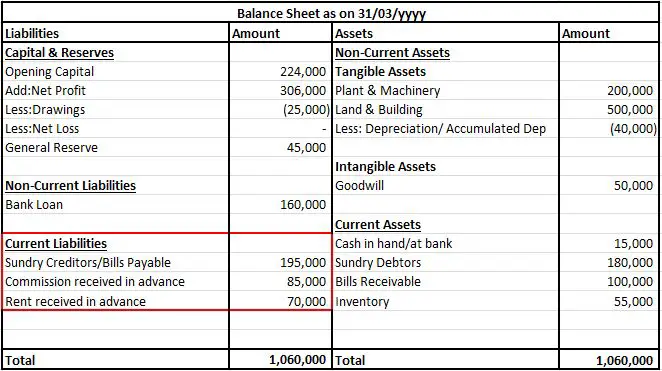
Balance Sheet Presented as a liability in the balance sheet under the head “Current Liabilities”

A snippet of the balance sheet has been attached to show the presentation of income received in advance.

Income received in advance presented in balance sheet

Conclusion

Income received in advance is a liability and not an asset.


>Related Long Quiz for Practice Quiz 31 – Income received in Advance


How to do bad debts adjustment in final accounts?

0

-This question was submitted by a user and answered by a volunteer of our choice.

Adjustment in final accounts

Adjustment of bad debts is often a tedious task for the students which ultimately leads to an error and false representation of the financial position of the business. They are adjusted in two ways depending on their record in the books of accounts, which is as follows;

1. Treatment of bad debts before preparation of trial balance

As a debtor fails to pay the due amount his account is credited and closed as well as a new account is opened known as the Bad debts account.

In the trial balance:
The net amount of bad debts incurred during the financial period and the Sundry debtors excluding the amount of bad debts appear as a separate item in the Trial balance on the debit side.

In the Income statement or the Profit and loss a/c:

Bad debts being an expense are recorded under operating expenses in the income statement or on the debit side of the Profit and loss a/c.


Journal entries for adjustment of bad debts:

Bad debts a/c Debit
To Sundry debtors a/c Credit

(being bad debts written off)


Profit and loss a/c Debit
To Bad debts a/c Credit

(being bad debts transferred to p&l a/c)


2. Treatment of bad debts after the preparation of trial balance

Sometimes the amount of bad debts may be mentioned as an adjustment item outside the Trial balance. These types of debts are often referred to as further bad debts and have not yet been written off. To provide a true financial position of the company it is necessary to include these bad debts while preparing the Final accounts.


In the profit and loss a/c:

They are added to the already written off bad debts and appear on the debit side of the profit and loss a/c.

In the balance sheet:

They are deducted from the adjusted sundry debtors on the asset side of the balance sheet.


Journal entry for adjustment of further bad debts:

Bad debts a/c Debit
To Sundry debtors a/c Credit

(being bad debts written off)


Example

The extract of the trial balance of XYZ Ltd. is as follows:

PARTICULARS DEBIT CREDIT
Sundry debtors 50,000
Bad debts 8,000


XYZ Ltd. sells goods to a retailer at 50 days credit. However, after 50 days, the company realizes that the retailer has been declared insolvent and only an amount of 4,000 will be received against the total amount of 8,000. The adjustment in the final accounts is as follows;

Bad debts a/c Debit 4,000 Debit all expenses and losses
To Retailers a/c Credit 4,000 Credit the giver

(being amount irrecoverable from the retailer)


Extract of Profit and loss a/c

PARTICULARS AMOUNT PARTICULARS AMOUNT
To Bad debts a/c        8,000
(+) further bad debts  4,000 12,000


Extract of balance sheet

Liabilities Amount Assets Amount
Sundry debtors           50,000
(-) Further bad debts   4,000
46,000


How to know if opening balance of an account should be debit or credit

0

-This question was submitted by a user and answered by a volunteer of our choice.

Opening Balance

The opening balance of an account can be found on the credit or debit side of the ledger account. Opening balance is represented by “Balance b/d”. When the opening balance is shown on the debit side then it is said to have a debit balance and when the opening balance is shown on the credit side then it is said to have a credit balance.

To make this concept clear, we will interpret the opening balances of various types of accounts with the help of their modern rules.


Asset

Asset shows positive (+) balance (or) debit balance. According to modern rules of accounting when there is an increase in the value of the asset the particular asset account gets debited and vice-versa. Cash a/c, Bank a/c, Machinery a/c, Building a/c etc., are a few most common examples of asset accounts.

Assets are shown Left Hand Side on the Ledger account and they are represented with the insertion “To” for recording all the debit side entries in a ledger. Opening balance of an asset is recorded by passing an opening entry i.e., “To Balance b/d”.

Dr                                                                Machinery Account                                      Cr

Particulars J.F. Amount Particulars J.F. Amount
“To” Balance b/d 500,000


Liability

Liability shows negative (-) balance (or) credit balance. According to modern rules of accounting when there is an increase in the value of liability the particular liability account gets credited and vice-versa. Creditors a/c, Bills payable a/c, Bank loan a/c etc., are a few most common examples of liability accounts.

Liabilities are shown Right Hand Side on the Ledger account and they are represented with the insertion “By” for recording all the credit side entries in a ledger. Opening balance of liability is recorded by passing an opening entry i.e., “By Balance b/d”.

Dr                                                          Bills payable Account                                        Cr

Particulars J.F. Amount Particulars J.F. Amount
“By” Balance b/d 700,000


Capital

Capital shows a negative (-) balance (or) credit balance. According to modern rules of accounting when there is an increase in the value of capital the particular capital account gets credited and vice-versa. Owner’s capital a/c, Partners capital a/c, Share capital a/c etc., are a few most common examples of capital accounts.

Capital is shown Right Hand Side on the Ledger account and they are represented with the insertion “By” for recording all the credit side entries in a ledger. Opening balance of capital is recorded by passing an opening entry i.e., “By Balance b/d”.

Dr                                                          Capital Account                                                  Cr

Particulars J.F. Amount Particulars J.F. Amount
“By” Balance b/d 700,000


Expense

Expense shows positive (+) balance (or) debit balance According to modern rules of accounting when there is an increase in the value of expense the particular expense account gets debited and vice-versa. Salary a/c, Rent a/c, Commission paid a/c etc., are a few most common examples of expense accounts.

Generally, expense accounts get closed by the end of every accounting year and their balances are not carried forward to the next accounting period. Hence there will be no opening balance for the expense account.


Income/Revenue

Income shows the negative (-) balance (or) credit balance. According to modern rules of accounting when there is an increase in the value of income the particular income account gets credited and vice-versa. Discount received a/c, Income received a/c, Rent received a/c etc., are a few most common examples of income accounts.

Generally, income accounts get closed by the end of every accounting year and their balances are not carried forward to the next accounting period. Hence there will be no opening balance for the income account.


Drawings Account

This is considered as an exception to this question. The drawings account is a contra account to the owner’s capital account because the owner’s withdrawal reduces the value of the owner’s equity. Drawings account debit balance is contradictory (opposite) to its anticipated credit balance of the owner’s capital account. Drawings have no opening balance.

Amount (or) goods withdrawn by the proprietor for his personal use is one of the most common examples of drawing.


Is capital an asset or liability?

0

-This question was submitted by a user and answered by a volunteer of our choice.

The simple meaning of capital, as known by many, is the sum of money invested in the business by the owner/shareholder/partners. It can be in the form of cash or assets. From the accounting perspective, capital is generally of three types, equity capital, debt capital, and working capital.


Capital as a Liability

A very common question that strikes us is that even though capital is invested by the owner in the form of cash or assets, why is it recorded on the liabilities side of the balance sheet? From the accounting perspective, Capital is a liability because the business is obliged to repay its owner.

To make the point clear, I would like to introduce you to the two different accounting perspectives of the same.


Internal Liability

Firstly, in the case of equity capital, it refers to ownership and represents the owner’s fund. The company is obliged to repay the owners as it is an internal liability and interest on capital is also paid during the operations of a company. A company is considered as a separate legal entity from its owner. The proprietor/shareholder/partners have invested the amount with an aim and expectation of profits in return.

However, the owners are repaid only if any amount is left after paying off all the obligations during the winding up of the company. It is not a mandatory liability like in the case of debt capital. It can also be represented as follows:

Assets = Liabilities + Capital

I have used the accounting equation to show the shareholder’s equity/capital as a difference and balancing figure between the company’s liabilities and assets. Since the capital invested is used to pay off all the debts, it has a credit balance and is recorded on the liabilities side of the balance sheet.


External Liability

Secondly, let us assume that company A has borrowed a certain sum of money from company B, and holds onto the amount invested for realizing feasible profits in the future. The company is obliged to repay, irrespective of profits or loss.

In simple words, I can conclude that capital is a liability.

Capital as shown in the balance sheet

Balance Sheet as of 31st March, YYYY

Liabilities Amount  Assets Amount
Capital 2,40,000 Cash in hand 70,000
(+) Net Profit 70,000 Accounts receivables 50,000
(-) Drawings (30,000) Patents 10,000
(-)Interest on capital (20,000) Equipment 45,000
Retained Earnings 10,000 Building 90,000
Sundry Creditors 40,000 Prepaid Expense 35,000
Outstanding Rent/Salary 5,000 Goodwill 20,000
General Reserve 10,000 Investments 60,000
Loan taken from Bank 55,000 Accrued Income 10,000
3,80,000 3,80,000


What is the journal entry for investment in subsidiary?

0

-This question was submitted by a user and answered by a volunteer of our choice.

To begin with, let me explain to you the meaning of a Subsidiary.

Meaning of Subsidiary

A subsidiary is a business entity in which another company termed as the parent/holding company owns & controls more than 50% of the share capital. If 100% share capital of an entity is owned by the parent company then such an entity will be referred to as a wholly-owned subsidiary.

The parent company will report the “investment in subsidiary” as an asset in its balance sheet. Whereas, the subsidiary company will report the same transaction as “equity” in its balance sheet.

Real-world examples of Holding & Subsidiary Company

1. Whatsapp & Instagram are subsidiaries of Facebook Inc.
2. Skype & LinkedIn are subsidiaries of Microsoft Corporation.


Journal Entry for Investment in Subsidiary

Suppose, Book Ltd acquires 60% shares in Paper Ltd in the month of April 20×1 against consideration of 5,000,000. In this case, more than 50% stake has been acquired by Book Ltd in the entity Paper Ltd. Therefore, Paper Ltd will be considered as a Subsidiary of Book Ltd.

Journal entry to be passed in the accounting records of Book Ltd at the time of acquisition;

Investment in Paper Ltd (Subsidiary) A/c Debit 5,000,000 Increase in asset
 To Bank A/c Credit  5,000,000 Decrease in asset


Presentation in Financial Statements

Financial Statement Treatment
Balance Sheet Presented separately as “Investment in Subsidiaries” under the head “Non-Current Assets”


What is the journal entry for payment to vendor?

0

-This question was submitted by a user and answered by a volunteer of our choice.

As we all know, a payment is made when we purchase a good or service on credit or cash basis. In terms of a business, a vendor (supplier/creditor) is a person who sells goods to the company on a cash or credit basis with an agreement to receive the payment within a specified period.

This in turn affects the accounts payables as the vendors are the creditors of the company as well as considered a short-term liability and are recorded under the head of current liabilities in the balance sheet.


Journal entry for payment to the vendor

  1. At the time of purchase of goods
Purchase a/c Debit Debit  the increase in expense
To Vendor a/c Credit Credit the increase in liability

(being goods purchased from the vendor on credit)


2. At the time of payment for purchased goods

Vendor a/c Debit Debit  the decrease in liability
To Cash a/c Credit Credit the decrease in asset

(being payment made to the vendor)


Example

XYZ Ltd. purchased goods from a vendor amounting to 60,000 on a credit basis in May and agreed to make the due payment in July. The journal entries in the books of XYZ Ltd. are as follows:

May Purchase a/c Debit 60,000
To  Vendor a/c Credit 60,000

(being goods purchased on credit from the vendor)


July Vendor a/c Debit 60,000
To  Cash a/c Credit 60,000

(being payment made to the vendor in cash)


Note: In case the company purchases the goods from the vendor directly for cash then only the following entry shall be passed in the books of accounts;

Purchase a/c Debit Debit the increase in expense
To Cash a/c Credit Credit the decrease in asset

(being goods purchased from the vendor for cash)