Monday, March 30, 2026
Home Blog Page 26

What is Double Entry Accounting System?

0

Double Entry Accounting

According to the dual aspect principle of accounting, business is a separate independent entity. Double-entry accounting system includes receiving benefits from some sources and giving it to some others. Benefits received and benefits provided should always match and balance out.

Every transaction has two aspects debit and credit; two equal amounts. Every business transaction has 2 effects. In the case when there are multiple accounts involved (compound journal entry), the total of debit entries must be equal to the total of credit entries.

Every transaction has 2 sides;

1. The receiver of the benefit 

2. Giver of the benefit

In all cases, Benefit Received  =  Benefits Provided


Example – Double Entry Accounting

Let us assume that a business purchases a building for 1,000,000, In this transaction, the business receives the ownership of the building and gives 1,000,000 to the seller.

The benefit received by the business is equal to the benefit given, which in this case sums up to 1,000,000.

Journal entry for cash purchase shown above is as follows;

Building A/C 1,000,000 Real A/C – Dr. what comes in
 To Cash A/C 1,000,000 Real A/C – Cr. what goes out  


Advantages of Double Entry Accounting System

A complete record of transactions, i.e. both sides of a transaction, give and take, are recorded, which in its turn helps to have a clear and much accurate image of a business’ profit or loss.

A comparison becomes possible as financial statements of one year can be easily compared with previous periods which can further help analyze upturns and downturns.

Accuracy is also enhanced by the double-entry system as it becomes possible to build a trial balance to try both the debit and the credit balances.

A double-entry system is a full proof scientific system as it records both sides of a transaction and no other system provides this level of accuracy.

Related Topic – Difference Between Finance and Accounting


Single Entry Accounting System

Also known as accounts from incomplete records, this type of accounting system is also called an incomplete double-entry system. A few transactions are recorded on the single side, a few  – on the double side and some are not recorded at all. Only cash book and personal accounts are maintained under this system. None of the accounts under this system is reliable.

Under a single entry accounting system, you can’t prepare a trial balance, income statement, and balance sheet.


Short Quiz for Self-Evaluation

Loading


>Read Bookkeeping


What are Accounting Principles?

0


Accounting Principles

There are general rules, guidelines and concepts in every field of study, accounting is no different. Accounting principles are accounting standards or rules that have been generally accepted. Based on these rules, accounting takes place and financial statements are made. If a company reports its financial statements to the public, it is expected to follow GAAP (Generally Accepted Accounting Principles) while preparing its financial statements.

Without the GAAP, companies would be free to decide for themselves what and how to report their financial information, making things quite difficult for investors and creditors who have invested in that company. GAAP makes a company’s financials comparable and understandable for investors, creditors and others to make intelligent decisions.

.

Principle of Income Recognition

It is also called the Revenue recognition concept. According to this concept, the income is considered to be earned on the date it is realized. In layman terms, income is considered as earned on the date when goods or services are transferred to a customer for cash or for a promise (credit). The terms of a contract between the buyer and the seller determine a point of sale. Generally, a sale is said to have been completed & ownership is considered to be transferred when goods are delivered to the buyer by the seller.

Key Highlights

  • It doesn’t matter when the cash is received for a particular transaction, the income will be recorded at the time of point of sale (POS).
  • Only revenue, which is realized, should be taken to the Income statement.


ExampleLet us assume that a company Unreal Corporation sells goods worth 20,000 to one of its buyers in January YYYY, but gets paid for them in March YYYY. The income from this sale should be recorded in the month of January when the goods were sold, and not in March. This is because a legal obligation was made in January.

A different example is when Unreal Corporation has received an advance for 20,000 in the month of January YYYY from one of its buyers for sales to be made in July YYYY. Now, in this case, the income would only be recognized in the month of July and not in January as the legal obligation is made in July.


Dual Aspect Principle

Also known as the Duality Principle, it is the most basic feature of an accounting transaction and is embodied in the double-entry system itself. This is linked to the business separate entity concept as a business is a separate, independent entity, it receives benefits from some and gives benefits to some others. Benefits received and benefits provided should always match and balance out. Every transaction will have two aspects, a debit and a credit, of equal amounts.

ExampleLet’s assume that Mr Unreal starts a business with 10,00,000 and buys a vehicle for 2,00,000 for official purpose. The current financial position of the business would be as follows:

Balance Sheet
 Liabilities  Assets
 Capital 10,00,000 Vehicle  2,00,000
 Cash  8,00,000
 10,00,000  10,00,000


The total liabilities are equal to the total assets. This is the dual aspect principle of accounting.

There were 2 aspects of each transaction mentioned in the example:

1. On one hand, the business gets an asset for 10,00,000 and on the other hand, has a liability of 10,00,000 towards Mr Unreal (Capital).

2. The second transaction, where Mr Unreal buys a vehicle for business priced 2,00,000, also has two effects: on one hand, it brings in an asset for 2,00,000 and on the other hand, it also reduces cash by 2,00,000 as a payment towards it.


Principle of Expenses

Expenses are not payments, a payment only becomes an expense when it is revenue in nature. It means that for a payment to be qualified as an expense, it has to be for consideration. All revenue expenses are transferred to the profit and loss account to ascertain profit or loss of the business undertaking. So, there are three different forms: revenue, expenses and capital payments. Revenue expenditure is charged against profits and is shown in the profit and loss account. However, capital payments are shown in the balance sheet as assets.


Example – Wages Paid is an example of an expense, where vehicle purchased for official purpose is an example of capital payment.


Modifying Principle

According to this principle, the cost of implementing a principle should not be more than the benefit derived from it. A cost and benefits analysis is necessary before applying the principle. If the cost is more than the benefit derived, then the principle should be modified. There should be flexibility in adopting a principle and the advantage out of the principle should overweigh the cost of implementing the principle.


One of the areas which govern the selection and application of accounting policy is

  • Substance over form: Transactions and events should be accounted for and presented in accordance with their substance and financial reality and not merely with their legal form. In accounting, the substance should normally take priority over form in deciding how a particular transaction should be recorded.


ExampleHire-purchase transactions are based on the substance over form principle, it looks at the substance of the transaction and not its legal form. The purchaser can record the asset at its cash down the price, while the payment for it can still happen as instalments over a pre-decided period of time.


Principle of Matching Cost and Revenue (Accruals)

The accrual or matching concept is an outcome of the periodicity concept. According to this principle, the expenses for an accounting period are matched against related incomes, instead of comparing the cash received and the cash paid. The revenue earned during a period is compared with the expenditure incurred to earn that income, whether the expenditure is paid in that period or not. This is called Accrual or the Matching Cost and Revenue Principle.

The principle is used to find the exact profit earned for that period. It is also important to give a true and fair view of the profitability and the financial position of a business.


Example

 Sales Revenue in 2013  10,00,000
 Expenses incurred in 2013  7,50,000
 Out of the above, expenses to be paid in  2014 are  1,50,000
   
 Net profit as per matching principle  10,00,000 – 7,50,000 =  2,50,000

 *Even if 1,50,000 is due in 2014, it will  still be considered as an expense for the year 2013.


Accruals are adjusted while preparing financial statements such as outstanding expenses, prepaid expenses, accrued income, and income received in advance.


Materiality Principle

The concept of materiality is the basis for recognizing a transaction in the entire process of accounting. Important details of the financial status must be provided to all relevant parties, insignificant facts which don’t influence any decisions of the investors or any interested party need not be communicated. According to the American Accounting Association, “an item should be regarded as material if there is a reason to believe that knowledge of the item would influence the decision of an informed investor“.

What is material or not depends on the nature and/or amount of item. For example, to make the accounting calculations manageable, amounts are rounded off to the nearest currency denomination. It all depends on judgement, there can’t be any hard and fast rule to determine if something is material or not. It also depends on the size of a business and this is usually measured in terms of turnover rather than profit. Once a thumb rule has been established, it is important that it is maintained uniformly from period to period.


Example1000 spent in an office on stationery may be material for a business with a turnover of 1,50,000 a year. However, the same amount may not be material for another business making 1,50,000,000 as annual turnover.


Historical Cost Principle

Also known as the Cost Principle. According to this principle, an asset is recorded in books of accounts at the price paid to acquire it. The cost thus recorded is the basis on which asset is later accounted. An asset is recorded at the cost price during the time of purchase but is consistently reduced in value by charging depreciation. In layman terms, an asset is recorded at its cost and this cost becomes the basis for all further accounting related to that asset.

This principle helps in achieving uniform accounting records under the condition of a stable price. However, under the condition of inflation, this cost concept doesn’t provide a true picture of a business. This led to the rise of Inflation accounting.


Example  – In case there is a piece of land that was bought for 10,00,000, it will continue to be shown at the same price in financial statements regardless of current or the future market value. It could be a case that the value of land is now appreciated to 10,50,000, however, it will still be shown at 10,00,000 only.


Full Disclosure Principle

Full disclosure means the act of fully making something evident. According to this principle, a business enterprise should disclose all the relevant information to all the relevant parties concerned with the business. Any significant matter affecting the financial statement should be disclosed. This principle defines that there should be understandable and complete reporting. The information of substance or of interest to an average investor will have to be disclosed in the financial statements.

Full disclosure is needed in cases where alternative options are available. For example, methods of depreciation such as straight line or diminishing value method, another example is LIFO/FIFO, etc. This principle helps in maintaining the relevance and reliability of financial statements. Even the company’s act 1956 requires that the income statement and the balance sheet of a company must give a fair and honest view of the state of affairs of the company.


Example

  1. Providing appending note to the financial statements is governed by this principle.
  2. Similarly, in the case of low turnover, the reasons should be clearly disclosed.

In both of the above examples, if the company fails to follow the standard guidelines, it would be considered as the concealment of material information and a violation of the full disclosure principle.


Principle Of Consistency

Consistency is one of the most sought for quality when it comes to performance. The same applies to a company’s operations. According to this principle, accounting practices once adopted should remain consistent, they are expected not to be changed. It is possible to adopt a variety of principles and procedures for business transactions. There are several areas in accounting where alternatives are present, for example, straight-line vs written down value methods of depreciation, valuation of closing stock, etc.

So, no matter which accounting approach a business follows, it should be kept consistent so that financial statements are comparable between different accounting periods. It should not be confused as a permanent or “Whatever-happens-it-can-not-change” type of principle. The accounting practices may be changed if the law demands, according to the accounting standard or in case it helps in a much better and meaningful demonstration of facts. In case a change occurs, it should be clearly mentioned and justified to the concerned authorities.


ExampleIf a company applies the straight-line method of depreciation to its fixed assets, it should be consistent in all the accounting periods and should not change to diminishing value or another depreciation method.


Principle of Conservatism or Prudence

According to the principle of conservatism, accountants follow the rule “anticipate no profits, but provide for all possible losses”. Whenever risk is anticipated, a sufficient amount should be kept aside to create a provision. This principle also requires that assets and profits should not be overstated. The value of investments for that matter is taken at cost, even if the market value is higher.

This principle helps to demonstrate the true picture of a business and ensure that a business is not window-dressed to deceive investors and other accounting information users.


ExampleIn case of evaluation of closing stock, it is valued at cost value or net realizable value whichever is less. This is to ensure that prudence and no profits are anticipated until sufficient evidence of the realization of profits is available.


Short Quiz for Self-Evaluation

Loading


What are Bad Debts?

0

Bad Debts

In a business scenario, amounts which are overdue to a business owner by the debtor(s) and declared irrecoverable are called bad debts. Few reasons for debtors to not pay their debts on time may be; filing for bankruptcy, experiencing hardship due to losses, etc. 

This can either be the complete amount owed or a part of the debt. Sometimes the amount may be recovered (partially or fully) in future. This is recorded with a journal entry for the recovery of debts.

While accounting for b/debts it is treated as a loss to business and reduces the total accounts receivable. The full amount should be written off to the “Income statement” of the related period or against the provision for doubtful debts. They are losses, hence they are debited and the debtor’s account is credited.


Journal Entry for Bad Debts

Bad Debts A/C Debit Nominal Account Dr. all losses
 To Debtor’s A/C Credit Personal Account Cr. the giver

As per modern rules of accounting;

Bad Debts A/C Debit Loss Dr. the increase in loss
 To Debtor’s A/C Credit Asset Cr. decrease in asset

At the time of preparing final accounts, debts which are written off during the period post-finalization of trial balance are transferred to the profit and loss account by recording the below journal entry.

Profit & Loss A/C Debit
 To Bad Debts A/C Credit

Related Topic – Difference Between Discount and Rebate


Explanation with Example

Let us assume that Mr Unreal, a sole proprietor, was supposed to pay 1,00,000 on an invoice to ABC Corp. However, he filed for bankruptcy and is declared insolvent. In this case, ABC Corp will go through the following accounting in their books:

At the time of realization (Assuming the opening balance was nil)

Bad Debts A/C 1,00,000
 To Mr Unreal A/C 1,00,000

At the time of transferring the amount to the P&L Account

Profit & Loss A/C 1,00,000
 To Bad Debts A/C 1,00,000

Related Topic – What are Non-performing assets or NPA?


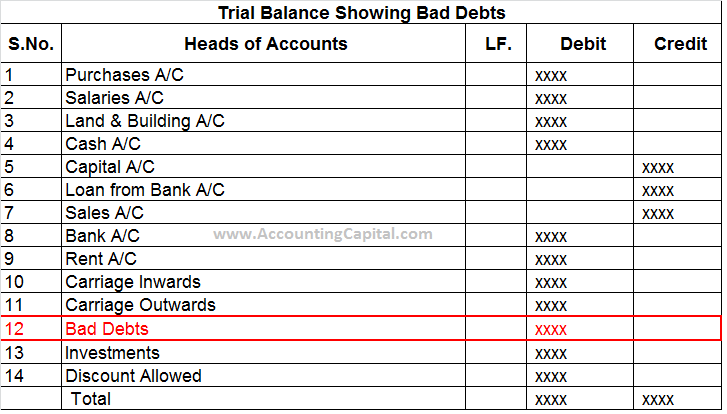
Bad Debts Shown in Trial Balance

Bad Debts Shown in Trial Balance


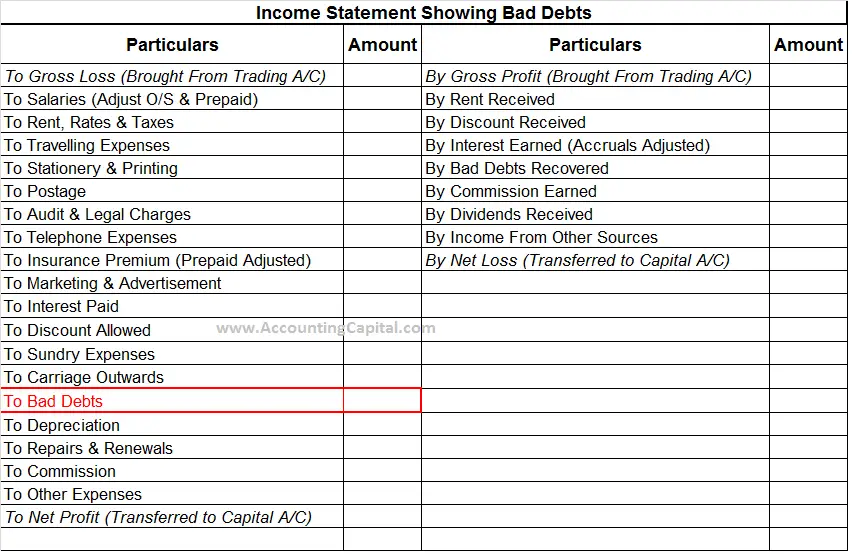
Bad Debts Shown in Income Statement

Bad debts shown in income statement


Short Quiz for Self-Evaluation

Loading


>Read Provision for Discount on Debtors


What are Different Accounting Concepts?

0


  1. What is Business Separate Entity Concept?
  2. What is the Going Concern Concept?
  3. What is Money Measurement Concept?
  4. What is Periodicity Concept?
  5. What is the Accrual Concept?

Accounting Concepts and Assumptions

Accounting concepts are basic assumptions on the basis of which financial statements of a business are prepared. Accounting assumptions are broad concepts that develop GAAP (Generally Accepted Accounting Principles) upon which all the accounting is based.

Certain ideas are assumed and accepted in accounting to provide uniform accounting practices. These uniform practices help the financial statements to be comparable both internally and externally leading to better analysis and interpretation of financial data.

Accounting Principles
Are the universally accepted rules on the basis of which accounting practices take place. They serve as a  guide for the selection of conventions or procedures among different alternatives.
 *Accounting Principles can be classified as concepts and conventions
Accounting Concepts Accounting Conventions
Basic assumptions on the basis of which financial statements of a  business are prepared.  Guidelines that arise from accounting practices,  a.k.a.  accounting principles.
These are the assumptions and conditions related to running a business. These are the customs and traditions related to running a business.
Example: A Business is started with an assumption that the business unit will operate for a long period of time and will not be dissolved in the near future. Example: A stock will be valued at the end of a  period, at the cost or the market price,  whichever is less.

Accounting concepts, Accounting principles and Accounting conventions are used interchangeably in most of the accounting books. We will, however, use them distinctively.


1. Business Separate Entity Concept

Also known as the Entity Concept. The essence of this concept is to consider a business as a separate entity different from the owner. It is an economic unit with its own identity.

For the purpose of bookkeeping, we must keep the owners and their business separate. A business unit has its own assets and liabilities. This enables the accountants and the business to differentiate between transactions of a company and private transactions of the owners.

Key highlights

  • Business and owners are different.
  • A firm has its own assets and obligations.
  • This makes it easy for accounting information users to segregate a transaction.

Example – Business Separate Entity Concept

Suppose there is a business started by Mr Unreal for 10,00,000 (1 Million) and he takes out 50,000 for his personal use. Now, if there was no separate entity concept, then the cash deduction would have ideally happened from the capital as an expenditure of the business.

Now, with the business entity concept in place, the cash deduction is termed as “Drawings” and shown as a 3rd party (the owner in this case) is drawing money out of the capital. The balance sheet after the deduction will be shown as:

Balance Sheet
 Liabilities      Assets    
 Capital  10,00,000    Cash     9,50,000
 Less Drawings  50,000  9,50,000      
     9,50,000      9,50,000

Related Topic – What are Accounting Principles?

2. Going Concern Concept

The basic assumption, in this case, is that a business will operate for a long time and there is no reason why a business should be encouraged for a short period only to dissolve it in the near future. The assumption is termed as the Going Concern Concept.

It is assumed that the business will not be dismissed in the near future. Financial statements are drawn with this assumption. The concept basically helps in the distinction between long-term or short-term expenses and liabilities. In case this concept is not followed, it should be clearly mentioned in the financial statements along with the appropriate reasons.

Key highlights

  • A strong assumption that an enterprise is a going concern and will continue operations for the foreseeable future.
  • Helps to determine short-term and long-term obligations of the business.
  • A business needs to clearly provide reasons if it doesn’t agree with this assumption.

Example – Going Concern Concept

Let us take the same example as previously used where Mr Unreal had invested 10,00,000 in his business. Mr Unreal purchased a vehicle for 2,00,000 before the end of the financial year. Now, if Mr Unreal decided not to follow the going concern assumption and sell off his business, the financial situation might be different due to loss or profit on the sale of the asset.

He might have less money on hand after selling off the vehicle. If the going concern is assumed, then the increase or decrease in the value of the asset in the short-term is ignored. Now, if Mr Unreal follows the going concern concept, the financial situation of the business at the beginning of the next financial period will be as follows:

Balance Sheet
         
 Liabilities      Assets  
 Capital  10,00,000     Vehicle  2,00,000
       Cash  8,00,000
     10,00,000     10,00,000 


3. Money Measurement Concept

All transactions of a business are recorded in terms of money. According to this concept, only transactions which can be recorded in terms of money are recorded.

In other words, an event or a transaction that can’t be expressed in terms of money can’t be recorded in the books of accounts. The reason for this is that money provides a uniform way to measure the value of goods and services.

Key highlights

  • If it has to go in the accounting books, it has to be measurable in terms of money.
  • The concept has its limitations and inadequacies.

Example – Money Measurement Concept

5 Trucks, 300 kg of raw material, 10 tables and 5 Chairs all make no sense to be mentioned in the books.

There are 2 major flaws with this concept:

  1. It assumes stability in the value of money, i.e. it doesn’t account for inflation.
  2. Many factors of vital performance are outside the purview of accounting.


4. Periodicity Concept

Also called the Concept of definite Accounting Period. According to this concept, the life of a business is broken into smaller periods called accounting periods so that the performance can be measured at fixed intervals. An accounting period could be a year, half-year or even a quarter.

It could be said that the business is here to stay for a long time, according to the going concern concept. So, the financial statements of the enterprise should be prepared at the end of its life.

It is possible, but not as practical as the users of financial statements need the information at regular intervals so that decisions can be taken in a timely fashion.

Key highlights

  • Even though the life of a business is considered indefinite (according to the going concern concept) it still needs to be divided into equal intervals for accounting purposes.
  • An accounting period is usually one year and is called the accounting year.

Periodicity concept of account

Example – Periodicity Concept

Let’s assume that if a financial company lasts for 150 years, it is impractical and undesirable to measure its performance and financial position at the end of 150 years. Therefore, the life of the company is divided into equal intervals to measure the financial position of the business. The periodicity concept results in the following benefits:

  • Comparing financial positions at different intervals.
  • Proper matching of periodic revenues and expenses to meet the objectives of accounting.
  • Consistent accounting treatment to find out profit and valuation of assets.


5. Accrual Concept

According to this concept, a transaction is recorded in the books of accounts at the time of their occurrence and not when the actual cash or a cash equivalent is received or paid.

The profit earned or the loss incurred for a period is the result of both cash and credit transactions, hence it is possible that certain incomes are earned but not received and, similarly, certain expenses are incurred but not yet paid during an accounting period.

It is relevant to consider them while working out the financial results, only because they are related to the concerned accounting period.

Key highlights

  • It doesn’t matter when the cash is paid or received. A transaction is recorded at the time of its occurrence.
  • Profit is said to be earned at the time the goods or services are sold to a customer, i.e. a legal title of the goods is passed to the customer.

Example – Accrual Concept

On December 31, 2013, the interest receivable on a fixed deposit was 1000 (assuming that the accounting year was to be closed on December 31, 2013). The interest amount was deposited in the bank on January 12, 2014.

According to the accrual concept, the income of 1000 from the interest on the fixed deposit belongs to the year 2013 and not 2014, even though the cash was actually received in 2014. The same applies to the expenses. Four important scenarios that emerge due to the accrual concept are:

  1. Prepaid expense
  2. Outstanding expense
  3. Accrued Income
  4. Income received in advance


What is the Accounting Process?

0

Accounting Process

The word “Accounting” brings along with itself thousands of years of history and can be traced back to ancient times. There are proofs which suggest that accounting might be more than 7000 years old. Now, let’s just quickly get back to modern times and try to understand what really accounting and the accounting process is all about.


Definition of Accounting:  Accounting is a set of concepts and techniques that are used to identify, measure, record, classify, summarize and report financial information of an economic unit to the users of the accounting information.

The economic unit is considered as a separate legal entity. Accounting information is widely used by various types of parties for several different reasons. Few of them are;

Who uses it Type of User  Main Purpose
Business Managers Internal For trends, budgeting and detecting performance bottlenecks
Owners Internal To interpret the profit and loss associated with the business
Employees Internal To check the financial health and keep a check on recent developments of  the business
Investors External They provide risk capital, to keep a track of ROI and associated risk
Lenders External Banks, NBFCs etc. they are mainly concerned with the financial stability of a  business to provide loans, overdraft, etc.
Government External Legal purposes of tax calculations, collect state and a country-level data
Research Agencies External To analyze financial health and accordingly provide ratings to the business
Creditors External To analyze the liquidity of a business and deciding a credit limit


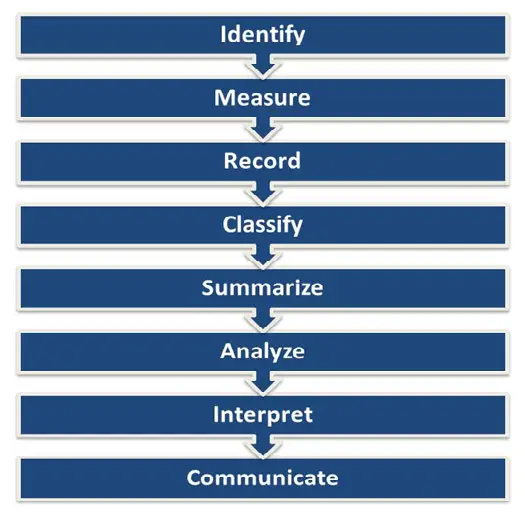
Process Flow of an Accounting Transaction

Accounting Process Chart


Example of Accounting Process: Let’s suppose there is a printer that was bought from HP for 5000 which was ultimately shown in the financial statements as an expense to the business.

Now, a purchasing manager looked into the expense at the year-end and recommended (the owners) a few cheaper alternatives to be considered for all future purchases.

Let us understand the ideal accounting process in this case

Process stepExplanation of the steps
IdentifyThe transaction "identified" was the purchase of a printer.
MeasureThe cost of the printer was "measured" as 5000.
RecordThe transaction was "recorded" in books systematically as 5000.
ClassifyThe transaction was then moved to the ledger and "classified" with similar transactions.
SummarizeHere the ledger balance was "summarized" and converted into trial balance and financial statements accordingly.
AnalyzePurchase manager "analyzed" the financial statements at year-end.
InterpretThe analysis leads to the "interpretation" that the printer was costly and cheaper alternatives were available.
CommunicateThis was "communicated" to the owners as a recommendation for future purchases of this kind.


Short Quiz for Self-Evaluation

Loading


>Read Accounting Cycle